Wall Paneling, Slats, Shiplap – How to Create Timeless Wall Design
Wall coverings are making a comeback: they improve acoustics, protect walls, and bring an architectural rhythm into the interior. MDF or wood panels wrapped with finish foil make it easy to choose the right decor, from warm oak tones to muted single colors, and to match walls with furniture fronts. This solution works especially well in hallways, TV zones, and behind the headboard.
What is wall paneling, and where does it come from?
Wall paneling is a wooden or board-based wall covering installed on interior walls. Its European roots go back to the 17th–18thcenturies – from the representative interiors of England and France tomiddle-class townhouses. In the past, it was made mainly from solid wood; today it is most often produced from MDF, which is easy to mill and wrap with finishfoil. This allows for both classic and modern effects (e.g., English paneling, panels with milled patterns).
Benefitsof wall coverings
- Aesthetics and rhythm. Slats and panels organize surfaces, adding depth and a play oflight-and-shadow.
- Acoustics. Rhythmic grooves and gaps reduce echo, improving acoustic comfort.
- Protection and durability. Wall coverings help absorb impacts and protect against scuffs, while finish foil makes cleaning easier.
- Concealment and zoning. They can hide cables or visually define zones.
- Material consistency. Using the same decor on furniture and walls creates a coherent, repeatable look.
- Flexible choice. From smooth panels to 3D options – it’s easy to match the scale to the room size and lighting.


Types of wall coverings: from slats to shiplap
Straight slats (rectangular strips)
Individual slats with a rectangular cross-section arranged in a regular pattern. They create a strong, orderly rhythm and clear geometry. They work well as a neutral wall base – from TV zones, through hallways, to a dining backdrop.
How to choose?
Select uni colors and wood with a calm, linear grain, or wood with a medium-scale pattern. Avoid very strong, high-contrast wood grain, as it competes with the rhythm of the slats.
Our recommendation: Nogal Mediterraneo 16-20253-104
Half-roundslats / quarter-rounds (fluted/half-round)
This is fluting (grooves in the profile) with rounded edges. Light falls more softly on them, so the effect is more decorative than with straight slats. A good choice if you want a gentler rhythm and less “angular” geometry.
How to choose?
Select uni colors and very calm wood with a fine pattern. Avoid pronounced, high-contrast grain – here the key role is played by the interplay of light-and-shadow within the profile.
Our recommendation: Arles Oak 16-18085-103
English paneling – the two most popular types
This is a wall divided into frames and panels, i.e., a “grid” of smaller rectangles.
- Raised panel: more classic, with stronger shadow and detail.
- Flat/Shaker panel: simpler and more modern, easy to pair with smooth uni-colors.
The layout can be further enriched with a vertical or horizontal rhythm of moldings.
How to choose?
With uni colors you can achieve a “painted” paneling effect. Subtle, elegant wood with low variation also works well. Avoid strong, “decorative” grain – the panel detailing and shadows are already visually pronounced.
Our recommendation: Narbonne Oak 16-10476-101
Shiplap /V-groove
A board effect created by a visible joint line: in shiplap it’s a small gap (rabbet), and in V-groove, a “V”-shaped groove. It can feel cozy (when lines are pronounced) or very modern (when the division is fine and precise). It works well when you want a “boarding” look without actual boards.
How to choose?
Uni colors with a very matte finish and wood with a neutral character. Avoid large, high-contrast grain with a strong pattern – when combined with board joints it will create visual “noise.”
Our recommendation: Sibiu Larch 16-01044-101
Framed (panel molding)
Thin moldings create rectangular “frames” on the wall, usually without deep panels. This is a lighter, more graphic version of paneling – it can be tone-on-tone or in a minimalist wood look. A related layout is board & batten (vertical battens dividing fields).
How to choose?
Uni colors (tone-on-tone), or very calm wood – here, the geometry of the divisions matters most. Avoid “showy” grain and high contrast.
Our recommendation: Lindberg Oak 16-10063-163
Large flat panels
Large, smooth formats create a calm, uniform plane. They can be joined flush or with even gaps that organize the divisions and add an architectural character. The best choice if you want minimalism and a clean surface.
How to choose?
Both calm and more expressive wood can work here, because it doesn’t compete with the profile geometry. You can go big with a larger grain scale and a more “furniture-like” wood decor.
Our recommendation: Salvador Oak 16-18020-134
Hexagons and “scales”
Small modules arranged like a mosaic – more decorative than large-format panels. Hexagons feel graphic and dynamic, while “scales” create a softer, more fluid pattern. Ideal as an accent or zoning element; with an additional backing layer they can slightly improve acoustics.
How to choose?
Uni colors in a matte finish or wood with low-contrast grain. Avoid large wood grain – with small modules, the pattern will be cut up and look random.
Our recommendation: Riviera Oak 16-10200-103
Micro-slats
Very narrow, densely repeated slats (a finer layout than straight slats). They create a more subtle effect than wide slats. Easy to use as ready-made panels, i.e., from milled MDF.
How to choose?
Uni colors and calm “background” decors work best. Avoid strong contrasts and large scale — the fine slat rhythm is already visually strong.
Our recommendation: Uni Pine Green 16-254080-810
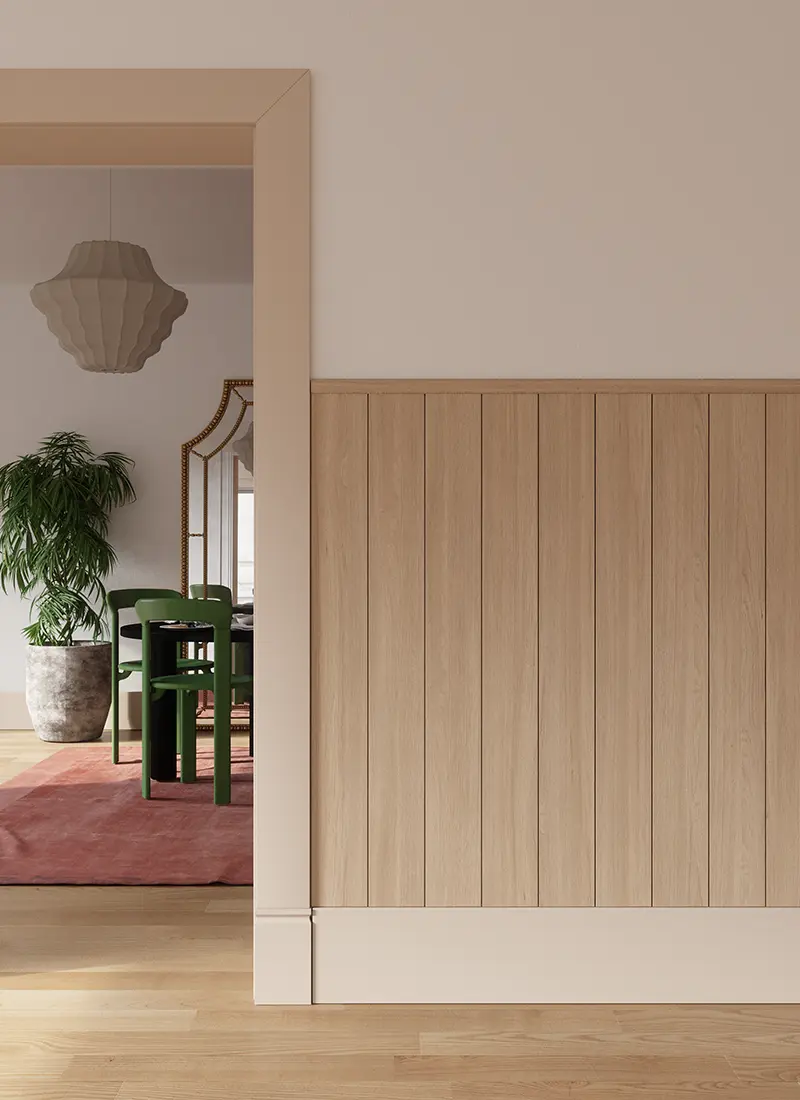
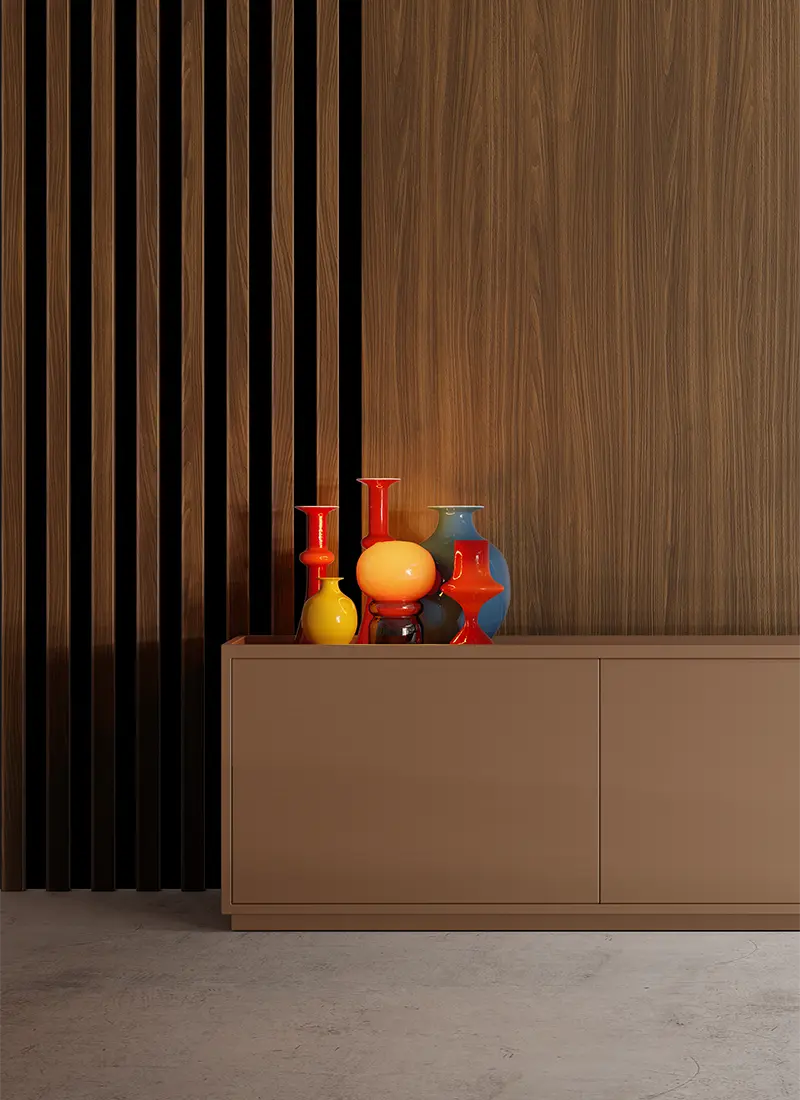

Coherent surfaces: how to combine wall coverings with flooring
Design can move from walls to floors and vice versa – increasingly, wall coverings are designed as part of a coherent set with flooring. When matching, three things matter: tone, color temperature, and pattern scale. This way, the wall can be a “continuation” of the floor (the same wood decor in a different format) or a conscious counterpoint (a uni color on the wall and wood on the floor).
Why are slats so popular?
Wall coverings and slats are popular today because they combine visual impact with practicality. Light-and-shadow adds depth, while also improving comfort: reducing echo and protecting walls in heavily used zones. For designers, it’s a quick way to build character without multiplying colors and accessories. For manufacturers and installers, it’s a modular solution, easy to adapt to different styles: from Japandi to modern classic. MDF-based versions finished with finish foil make it easier to keep consistent with furniture and doors. That’s why wall coverings are increasingly becoming an element that ties the whole interior together, rather than just decorating a single wall.